gran model luding model#
Syntax#
model luding [other model_type/model_name pairs as described here] keyword values
Examples#
pair_style gran model luding tangential tan_luding
Description#
This model is a part of pair gran and fix wall/gran to compute the contact force between a pair of granular particles, for adhesive elasto-plastic contacts proposed by Luding. This takes into account particles which undergo elastic and plastic deformations.
The contact model is consists of normal and tangential force components. The normal force has the following components: hysteretic spring, damping and a constant pull-off force while the tangential force has the following components: spring, damping and friction force. The tangential force is computed by specifying the command tangential tan_luding. Additionally, the tangential spring force is a “history” effect that accounts for the tangential displacement/overlap between the particles for the duration of the time they are in contact.
Normal and tangential force:#
The normal contact force is a sum of the hysteretic spring, damping and a constant pull-off force:
The normal force terms are given as follow. \(\eta_n\) is the normal damping coefficient, \(\pmb{v}_{r,n}\) is the translational relative normal velocity and \(\pmb{n}\) is the unit normal vector between particle centres. \(f_{hys}\) and \(f_0\) are magnitudes of the hysteristic spring and constant pull-off forces respectively. The hysteristic spring force is described in detail in the following section.
The tangential contact force is evaluated based on the criteria below. In the no-slip condition, the force is computed as the sum of the spring and damping terms. This is true until the Coulomb criteria/slip condition is met, where the force is then given by the Coulomb friction force.
The equations of the tangential terms are given below. \(\mu_s\) and \(\mu_d\) are the static and dynamic friction coefficients. \(k_t\) is the tangential stiffness, \(\delta_t\) is the particle overlap in the tangential direction, \(\eta_t\) is the tangential damping coefficient, \(\pmb{v}_s\) is the relative tangential velocity at the contact surface, \(F_N\) is the effective normal force and \(\pmb{t}\) is the unit tangential vector.
As mentioned above, the tangential overlap \(\delta_t\) is evaluated throughout the duration when the particles are in contact. This is computed by integrating the relative tangential velocity at the contact surface \(\pmb{v}_s\) over time.
The torque due to the tangential contact force is then computed as follow where \(r\) is the particle radius.
Linear hysteristic spring model:#
In Luding’s model, \(f_{hys}\) is modelled as a linear hysteretic spring. The force-displacement relationship for normal contact is depicted and calculated in the figure (Luding, 2006) and equation below.
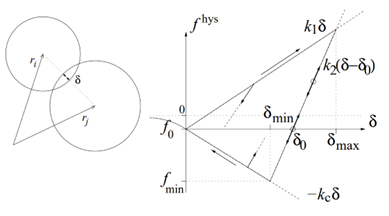
\(k_1\), \(k_2\) and \(k_c\) are the loading, unloading and adhesive stiffness while \(\delta\) is the normal overlap distance of two particles.
During initial loading, the contact follows along the loading path \(k_1\).
Upon unloading, the contact switches to the unloading/reloading path \(k_2\), reaching zero force at overlap \(\delta_0\), which describes the plastic contact deformation. If reloading occurs, the contact remains on the \(k_2\) path but reverts to the initial loading path \(k_1\) if the previous historical maximum loading force is exceeded.
Unloading below the plastic overlap \(\delta_0\) leads to an attractive adhesion force until the maximum adhesive force \(f_{min}\) is reached at \(-k_c \delta_{min}\). Further unloading leads to reduction of the attractive force until separation occurs at zero overlap. If reloading occurs on the adhesion branch, the contact follows a \(k_2\) path parallel to the unloading/reloading path until it reaches the initial loading path \(k_1\). A constant pull-off force \(f_0\) value can also be specified.
In the model, the \(k_2\) value is dependent on the maximum overlap to account for increasing particle stiffness with deformation. An additional quantity, the plastic flow limit overlap \(\delta^*_{max}\), is computed from the equation below. \(\Phi_f\) is the dimensionless plasticity depth (defined relative to the reduced radius \(\overline{r}\)) and \(k_{2,max}\) is the maximum unloading stiffness.
\(k_2\) is interpolated linearly between \(k_1\) and \(k_{2,max}\) until the overlap reaches the the plastic flow limit overlap:
Coefficients, effective normal force:#
The maximum unloading, adhesive and tangential stiffness are defined in relation to the loading stiffness:
The normal damping coefficient for a linear contact model is computed as below while the tangential damping coefficient is given as a fraction of the normal damping coefficient. \(\overline{m}\) is the reduced mass and \(e\) is the restitution coefficient.
The dynamic friction coefficient is also specified in terms of the static friction coefficient where \(\mu_d \le \mu_s\):
The effective normal force in Luding’s model is calculated as:
Velocities and reduced/effective parameters:#
The translational relative normal velocity is given as follow. The subscripts \(_i\) and \(_j\) refer to particles i and j respectively.
The relative tangential velocity at the contact surface is given as the sum of the translational relative tangential velocity and the rotational relative velocity:
The reduced radius and mass are calculated as follow:
Time step estimation:#
The simulation timestep for Luding’s model can be estimated from the equation below (as a fraction of the contact time \(t_c\)):
\(\omega\) is the eigenfrequency of the contact given as follow where \(\eta_{n0}\) is the rescaled damping coefficient.
Initialisation#
This model requires the following material properties/parameters to be defined as given below via multiple fix property/global commands.
Normal force parameters:
fix id all property/global coefficientRestitution peratomtypepair n_atomtypes value_11 value_12 .. value_21 value_22 .. .
# (value_ij=value for the coefficient of restitution between atom type i and j)

fix id all property/global LoadingStiffness peratomtypepair n_atomtypes value_11 value_12 .. value_21 value_22 .. .
# (value_ij=value for the loading stiffness between atom type i and j)

fix id all property/global UnloadingStiffness peratomtypepair n_atomtypes value_11 value_12 .. value_21 value_22 .. .
# (value_ij=value for the maximum unloading stiffness (defined relative to the loading stiffness) between atom type i and j)

fix id all property/global coefficientAdhesionStiffness peratomtypepair n_atomtypes value_11 value_12 .. value_21 value_22 .. .
# (value_ij=value for the adhesion stiffness (defined relative to the loading stiffness) between atom type i and j)

fix id all property/global coefficientPlasticityDepth peratomtypepair n_atomtypes value_11 value_12 .. value_21 value_22 .. .
# (value_ij=value for the dimensionless plasticity depth (defined relative to the reduced radius) between atom type i and j)

fix id all property/global pullOffForce peratomtypepair n_atomtypes value_11 value_12 .. value_21 value_22 .. .
# (value_ij=value for the constant pull-off force (in unit N)(value<=0) between atom type i and j)
Tangential force parameters:
fix id all property/global coeffFrictionStiffness peratomtypepair n_atomtypes value_11 value_12 .. value_21 value_22 .. .
# (value_ij=value for the tangential stiffness (defined relative to the loading stiffness) between atom type i and j)

fix id all property/global coefficientFriction peratomtypepair n_atomtypes value_11 value_12 .. value_21 value_22 .. .
# (value_ij=value for the static friction coefficient between atom type i and j)

fix id all property/global FluidViscosity peratomtypepair n_atomtypes value_11 value_12 .. value_21 value_22 .. .
# (value_ij=value for the dynamic friction coefficient (defined relative to the static friction coefficient)(value<=1) between atom type i and j)

fix id all property/global FrictionViscosity peratomtypepair n_atomtypes value_11 value_12 .. value_21 value_22 .. .
# (value_ij=value for the tangential damping coefficient (defined relative to the normal damping coefficient) between atom type i and j)
Note
You have to use atom styles beginning from 1, e.g. 1,2,3,…
Summary of parameter names and their symbols:
coefficientRestitution: \(e\)
LoadingStiffness: \(k_1\)
UnloadingStiffness: \(C_{k2,max}\)
coefficientAdhesionStiffness: \(C_{kc}\)
coefficientPlasticityDepth: \(\Phi_f\)
pullOffForce: \(f_0\)
coeffFrictionStiffness: \(C_{kt}\)
coefficientFriction: \(\mu_s\)
FluidViscosity: \(C_{\mu d}\)
FrictionViscosity: \(C_{\eta t}\)
Symbol list#
\(C\): Parameter constants (-)
\(e\): Restitution coefficient (-)
\(\pmb{F}_{C}\): Contact force (N)
\(\pmb{F}_{hys}\), \(\pmb{F}_{damp}\), \(\pmb{F}_0\), \(\pmb{F}_{fric}\): Hysteristic spring, damping, pull-off and friction force (N)
\(F_N\): Effective normal force (N)
\(k_1\), \(k_2\), \(k_{2,max}\), \(k_c\): Loading, unloading, maximum unloading and adhesive stiffness (N/m)
\(\overline{m}\): Reduced mass (kg)
\(\pmb{M}_{C}\): Torque due to contact force (N.m)
\(\pmb{n}\), \(\pmb{t}\): Unit normal and tangential vector (-)
\(\overline{r}\): Reduced radius (m)
\(t_c\): Contact duration (s)
\(\pmb{v}_r\): Translational relative velocity (m/s)
\(\pmb{v}_s\): Relative tangential velocity at the contact surface (m/s)
\(\delta\): Overlap (m)
\(\delta^*_{max}\): Plastic flow limit overlap (m)
\(\Delta t\): Simulation/integration timestep (s)
\(\eta\): Damping coefficient (N.s/m)
\(\mu_d\), \(\mu_s\): Dynamic and static friction coefficient (-)
\(\Phi_f\): Dimensionless plasticity depth (-)
\(\omega\): Eigenfrequency of the contact (1/s)
\(\pmb{\omega}_r\): Rotational relative velocity (rad/s)